
Complete Range
Wide Knowledge
Value Adding Focus

0
Complete Range
Wide Knowledge
Value Adding Focus
Want to reduce film consumption, lower your cost per pallet and make your pallet wrapping process more efficient? The key is finding the right combination of machine, stretch film and settings. When everything is tailored to your pallet flows and specific needs, you can improve load stability, reduce material consumption and achieve more cost-efficient operations.
Pallet wrapping involves wrapping goods on a pallet with stretch film to keep the load stable and protected during storage and transport. Too little film can compromise load stability, while too much leads to unnecessary material consumption and higher costs. The goal is therefore not to use as little film as possible, but to use the right amount of the right stretch film.
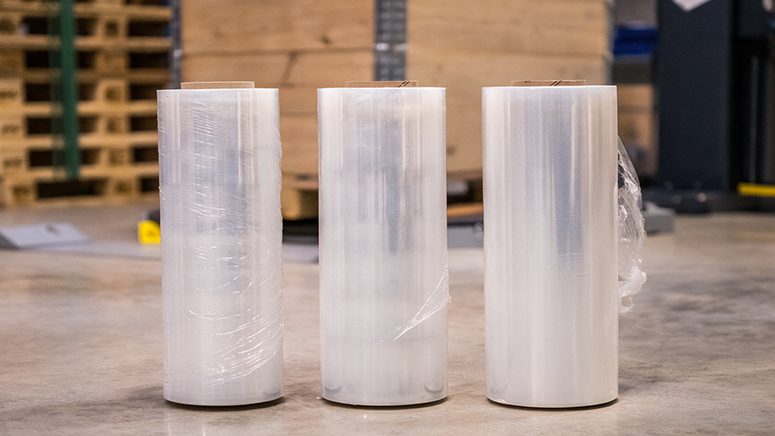

Manual wrapping can work well for smaller pallet volumes. However, as the number of pallets increases, the process becomes both time-consuming and physically demanding. It can also be difficult to achieve consistent results.
When pallet wrapping becomes part of your daily operations, investing in a machine often pays off. A stretch film machine gives you better control over film consumption, more consistent wrapping and a more efficient workflow.
The best choice depends on your pallet handling processes.
Stretch film robot
A flexible solution when pallets need to be wrapped in different locations or when loads are large or irregularly shaped.
Stationary stretch film machine
A good choice when pallets are handled in a fixed location. Ideal for businesses looking for efficient, consistent wrapping as part of their daily operations.
For higher pallet volumes and automated processes, solutions with rotating arms or rings are also available.
Stretch film is available in different thicknesses and grades, including options containing recycled materials. But thinner or thicker film is not automatically better. What matters is how the film performs with your machine and how effectively it protects the load.
Pre-stretch means that the film is stretched before being applied to the pallet. With the right pre-stretch level, you can use film more efficiently and reduce material consumption. However, the film must be compatible with the machine's pre-stretch capabilities and settings to avoid issues such as film breaks or insufficient load stability.

Choosing a machine and stretch film separately, based solely on price, does not always deliver the best overall value. By matching the machine, film and settings to your needs, you can achieve several benefits:
If the film frequently breaks, loads become unstable or film consumption is high, it may be a sign that your machine, film and settings need to be reviewed.
To find the right solution, start by asking yourself a few simple questions:
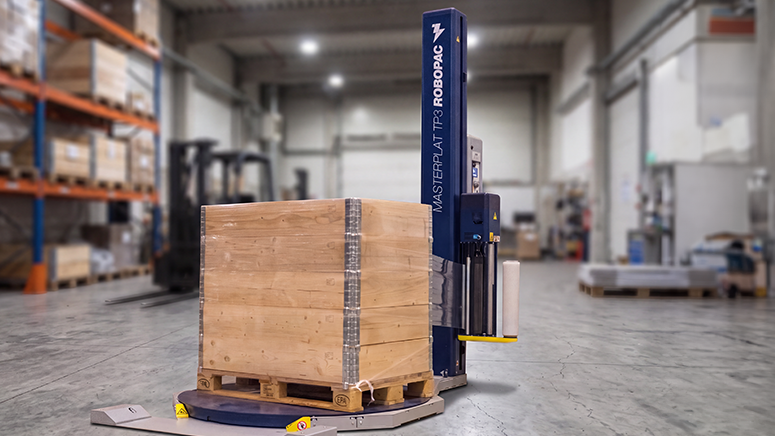
Pictured: Robopac stretch film machine. Boxon is an authorised Robopac reseller in Sweden only.
How much stretch film should you use per pallet?
It depends on the characteristics of the load, the film and the machine settings. The goal is to use enough film to ensure load stability without unnecessary material consumption. A good starting point is to measure your current film consumption in grams per pallet.
Is the thinnest stretch film always the most sustainable choice?
No. Thinner film may require additional wraps to provide sufficient stability. What matters is the total material consumption and ensuring that the goods remain protected during transport.
What does 200% pre-stretch mean?
It means that one metre of film is stretched to three metres before being applied to the pallet. This can help optimise film consumption, provided that the film is suitable for the specified pre-stretch level.
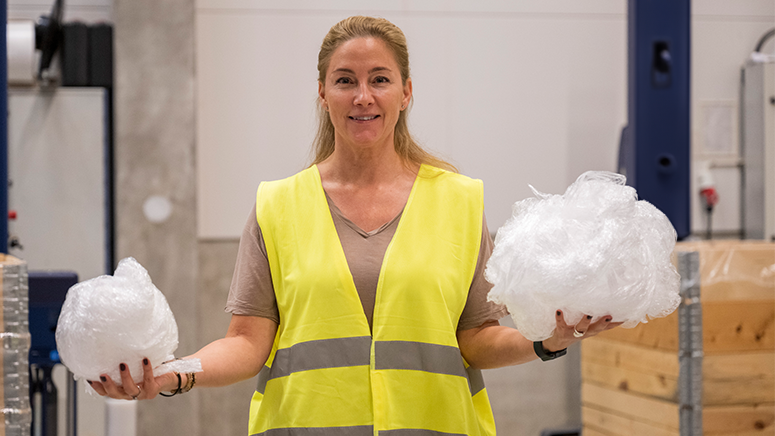
Efficient pallet wrapping is not about choosing the cheapest machine or the thinnest film. It's about finding the right combination of machine, stretch film and settings for your specific needs.
We're happy to help you find the right combination of machine and stretch film – from selecting the right solution to installation, optimisation and service.

